
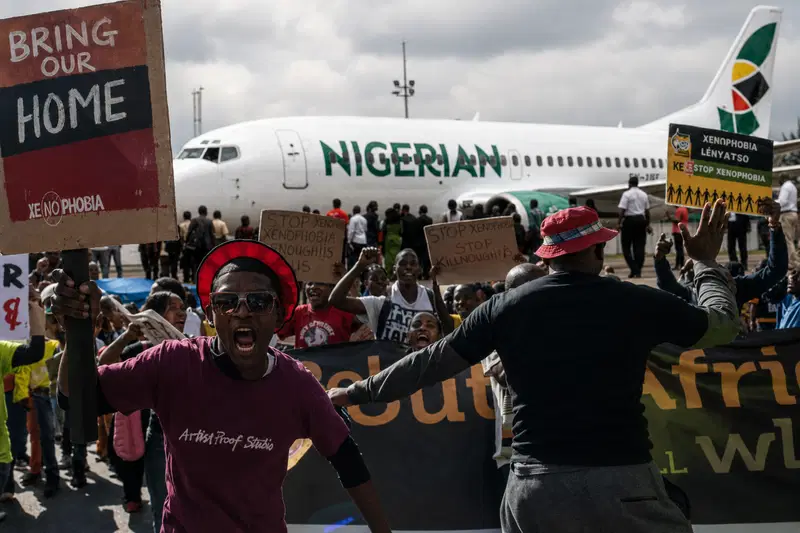

LAGOS — The Federal Government has commenced arrangements to evacuate Nigerians willing to return home from South Africa following renewed anti-foreigner protests and rising tensions in parts of that country.
Minister of Foreign Affairs, Mrs. Bianca Odumegwu-Ojukwu, disclosed this, yesterday, after a telephone discussion with South Africa’s Minister of International Relations and Cooperation, Mr. Ronald Lamola, over recent demonstrations and growing hostility against migrants, especially in Durban.
According to Odumegwu-Ojukwu, the South African minister expressed reservations about Nigeria’s evacuation plans, but she insisted that the Nigerian government cannot ignore the continued harassment and alleged extra-judicial killings of its citizens living in South Africa.
She said: “I maintained that our government cannot stand by and watch the systematic harassment and humiliation of our nationals resident in SA, as well as the extra-judicial killings of our people, and that the evacuation of our citizens who want to return home remains our government’s priority at this time.”
The minister urged South African authorities to treat reported killings of Nigerians with greater urgency, stressing that perpetrators must face immediate sanctions.
She explained that although the protest held in Durban on Wednesday did not degenerate into violence due to the heavy deployment of security personnel, Nigerians in the area were advised by the Nigerian Mission to shut their businesses and stay indoors for safety reasons.
‘Inflammatory rhetoric, hostile actions’
Odumegwu-Ojukwu also expressed concerns over what she described as inflammatory rhetoric and hostile actions by anti-foreigner groups in South Africa, warning that the situation posed serious risks to the lives and property of Nigerians and other African migrants.
She said Nigerians in South Africa had continued to show restraint despite mounting provocation, adding that persistent attacks and hostility could also affect South African businesses and interests in Nigeria.
The minister further revealed that Nigerian families had reported incidents of bullying involving Nigerian children and children born to Nigerian and South African parents, commonly referred to as “Sougerians.”
According to her, some of the children were allegedly mocked in schools and told to “return to their country,” a situation she described as disturbing and capable of leaving emotional and psychological scars on the victims.
She said Lamola assured her that South African authorities acknowledged their responsibility to protect the affected children and are already engaging relevant education agencies to address the issue.
While both countries agreed to sustain diplomatic engagement aimed at easing tensions, Odumegwu-Ojukwu questioned the continued description of the attacks as xenophobia.
“The demand that all foreigners leave South Africa appears to be targeted only at black Africans, which makes one wonder whether what is happening should not be more accurately defined as ‘Afrophobia’ rather than xenophobia,” she stated.
She also disclosed that President Bola Ahmed Tinubu had directed Nigerian missions in South Africa to immediately establish crisis notification centres to assist Nigerians facing threats or distress.
The minister added that Nigerians experiencing danger or intimidation had been advised to promptly report such incidents to South African security agencies.Economists caution against blanket sanction on S’African companies
Meanwhile, as tension continues to mount over the incessant xenophobic violence against Nigerians, economic experts have warned against imposing blanket sanctions on South African companies operating in the country, saying that it will amount to self-sabotage. The call for caution came amid repeated calls from various quarters, including from the Senate, urging the Federal Government to go beyond diplomatic pressure and explore economic sanctions, particularly targeting South African multinational companies operating in Nigeria.
Senator Adams Oshiomole, (APC, Edo North), had at plenary in the Senate on Tuesday, suggested that the operating licences of MTN Nigeria Plc and Multichoice Group among others should be revoked.
Arguing for economic retaliation, Oshiomhole proposed nationalizing MTN Nigeria and suggested a 30-day boycott of its services. The lawmaker said that Nigeria must respond firmly to protect its citizens, citing the principle of reciprocity in international relations. “I don’t want this Senate to be shedding tears, to sympathise with those who have died. We didn’t come here to share tears. If you hit me, I’ll hit you. I think it is appropriate in diplomacy. It’s an economic struggle,” he said.
Similarly, the National Association of Nigerian Students, NANS, South West Zone D, Wednesday, threatened to stage demonstrations against South African businesses in Nigeria following the eruption of fresh xenophobic attacks that reportedly led to the death of Nigerians. The students’ body said it is mobilising its members for peaceful demonstrations and mass advocacy targeting major South African-linked companies, including MTN Nigeria and MultiChoice Group.
But sounding a note of caution, the economists, who spoke with Vanguard in separate interviews, said adopting the measure was neither a viable nor an effective response.
Similar reprisal attacks in 2019 had seen mobs invade several Shoprite outlets and MTN in Lekki, Jakande, and Surulere areas of Lagos, destroying and looting properties. The companies were, again, subjected to similar treatment during the 2020 EndSars protest in Lagos.
Retaliatory action does not pressure actual perpetrators — Onyedikachi
Reacting, Miss Nnoruga Onyedikachi, Ag. Head of Research at FSL Capital Limited, said: “Economically, a blanket shutdown of South African blue-chip companies operating in Nigeria is neither a viable nor an effective response. The xenophobic attacks in South Africa are largely localized incidents, driven by deep-seated socio-economic pressures such as unemployment, inequality, and social tensions. As such, targeting multinational corporations does not necessarily address the root causes of the violence, nor does it meaningfully pressure the actual perpetrators. “Ill-conceived retaliatory actions, particularly those involving violence, would amount to economic self-sabotage, and heighten uncertainty without guaranteeing any substantive behavioral or change in South Africa.”
Onyedikachi emphasised the need for government to prioritize enforceable protection for the citizens through a combination of robust diplomatic engagement and targeted state action. This, she said, would include “immediate steps such as rapid consular intervention to support affected Nigerians, the development of clear evacuation frameworks where risks escalate, and sustained diplomatic escalation to ensure the issue remains at the forefront of bilateral and multilateral discussions.”
She said that Abuja could raise the reputational and political costs for South Africa by formally engaging regional and international bodies such as the African Union and the United Nations. “By internationalizing the issue, Nigeria can compel greater accountability and encourage the South African government to take more decisive action against perpetrators,” she remarked.
About The Author