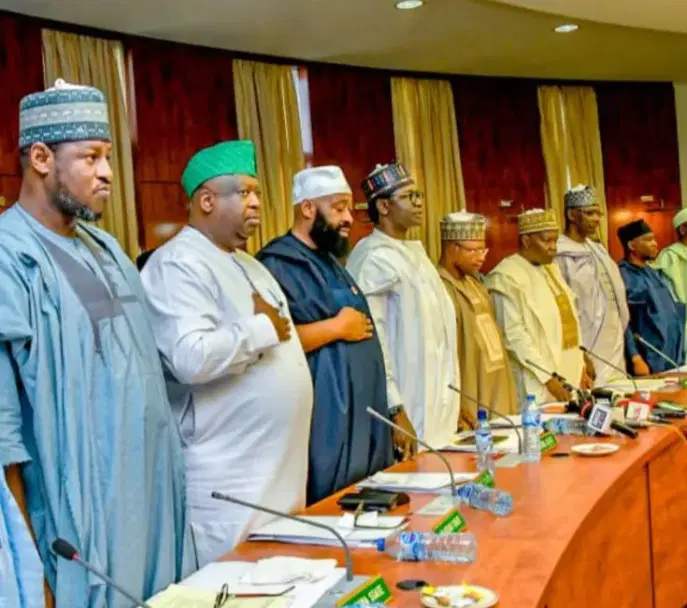

Faced with a persistent wave of security challenges across the country, the 36 state governors of the Federation have renewed their push for the swift establishment of state police. Operating under the umbrella of the Nigeria Governors’ Forum (NGF), the state executives declared that decentralizing the nation’s security architecture has become an urgent constitutional necessity to effectively safeguard lives, property, and local communities.
The high-powered resolution was reached during the NGF’s second plenary meeting in Abuja, which concluded under the leadership of the forum’s Chairman, Kwara State Governor AbdulRahman AbdulRazaq.
While throwing their full institutional weight behind the policy, the governors stressed a critical caveat: the upcoming decentralised policing framework must be robustly structured to be constitutionally sound, fully aligned with true federalism, and rigidly protective of fundamental citizens’ rights.
Legislative Momentum: The Constitutional Amendment Bill
The governors’ intensified demand follows a historic milestone in the National Assembly. Just days prior, on June 11, a constitutional amendment bill seeking to permit states to establish, fund, and manage their own law enforcement structures scaled second reading in both chambers.
The legislative traction was particularly pronounced in the House of Representatives, where the bill secured an overwhelming majority of 289 votes out of the 290 lawmakers present.
To prevent the decentralized forces from mutating into political instruments or “private armies” controlled by regional executives—a long-standing concern raised by civil rights groups—the NGF has formally directed the 36 state Attorneys-General to review the ongoing legislative draft. This legal committee is tasked with embedding strict oversight mechanisms, accountability measures, and operational guidelines directly into the final amendment.
Beyond Policing: Energy Reforms and Welfare Initiatives
While national security dominated the front-page discourse, the communique read by Ogun State Governor Prince Dapo Abiodun revealed that the state executives addressed other critical socio-economic sectors, notably power generation and human capital development:
Key National Initiatives Approved by the NGF
| Sector / Initiative | Primary Operational Objective | Strategic Partnership Framework |
|---|---|---|
| State Police Readiness | Governance, financing, and digital standards for state forces | State Attorneys-General & National Assembly |
| National Solar Super-Grid (NSSG) | Decentralised large-scale solar generation for local markets | Federal Ministry of Power & Private Investors |
| National Nutrition 774 (N-774) | Combating severe child malnutrition across all 774 LGAs | Federal Government & Healthcare Agencies |
| AGROW Value-Chain Programme | Boosting agricultural yields and food security (FY2026–2032) | World Bank Country Office |
The governors expressed robust optimism regarding the National Solar Super-Grid (NSSG) Initiative, noting that integrating decentralized solar farms into the high-voltage transmission network would rapidly expand electricity access, insulate state economies from national grid collapses, and catalyze regional industrialization.
Addressing the Roots of Sub-National Vulnerability
Despite the strong administrative momentum, prominent public policy experts urge caution. Former Minister of Education, Dr. Obiageli Ezekwesili, noted that while a regional policing model provides immediate tactical relief, the core security crisis is deeply tied to structural macroeconomic failure and systemic poverty.
The governors, however, maintain that local intelligence gathering is impossible under a highly centralized command chain headquartered hundreds of miles away in Abuja. By synchronizing the state police legal framework with the World Bank-backed AGROW value-chain initiative and sub-national energy markets, the NGF intends to create a secure environment capable of attracting private capital back to Nigeria’s rural communities.
About The Author