
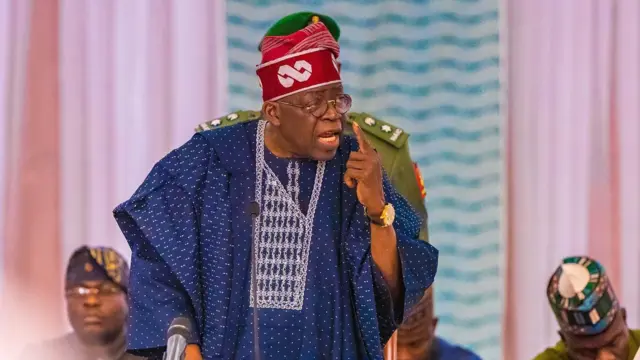
Political Friction: Presidency and Opposition Lawmaker Dismiss Calls for Tinubu’s Resignation

The presidency alongside elements within the federal legislative opposition have firmly pushed back against coordinated calls demanding the resignation of President Bola Ahmed Tinubu over the nation’s prevailing security and economic headwinds. The administration labeled the demands an unrealistic “social media circus” deliberately timed to score early political points ahead of the 2027 general elections.
The intense political friction was triggered by statements from the Nigerian Democratic Congress (NDC) presidential candidate, Peter Obi, and the House of Representatives Minority Leader, Fred Agbedi. Obi publicly urged President Tinubu to mirror the recent resignation of UK Prime Minister Keir Starmer, who stepped down following intense public frustration over a stagnant British economy and cost-of-living challenges.
Systemic Differences: The Presidency’s Institutional Rebuttal
Reacting sharply to the comparison, presidential aides Bayo Onanuga and Dada Olusegun dismissed Obi’s logic, pointing out a fundamental misunderstanding of constitutional frameworks. The administration noted that equating the United Kingdom’s parliamentary structure with Nigeria’s presidential system is completely flawed.
[UK Parliamentary Model]   ──► Prime Minister Answers Directly to Party & Legislature (Fluid Tenure)
[Nigerian Constitutional]  ──► Executive President with Fixed 4-Year Mandate (Designed for Stability)
The presidency maintained that President Tinubu inherited an economy weighed down by decades of unsustainable fuel subsidies, multiple artificial exchange rate windows, and dwindling oil production. According to the executive briefs, fixing these deeply rooted structural distortions inevitably triggers short-term hardship, but remains non-negotiable for long-term national survival.
Fractured Opposition: The Battle Within the House
Simultaneously, a major political rift has torn through the opposition caucus inside the National Assembly. While Minority Leader Fred Agbedi (PDP) insisted the President should step down if immediate economic and security solutions are not met, his colleague, Hon. Philip Agbese, openly revolted against the position.
Agbese—who represents the Ado/Okpokwu/Ogbadibo Federal Constituency of Benue State under the Labour Party (LP) and serves as the Deputy House Spokesperson—slammed the resignation call as unpatriotic and partisan.
[House Minority Leader Agbedi (PDP)] ──► Demands Resignation Over Insecurity/Economy
                                              ▲
                                              │ (Caucus Split)
                                              ▼
[Deputy House Spokesperson Agbese (LP)]   ──► Rejects Call; Labels it an Outside 2027 Conspiracy
“The call for the resignation of President Tinubu is not borne out of patriotism,” Agbese stated, suggesting that opposition elements are being manipulated by external forces eyeing the presidency in 2027. He emphasized that resolving complex security challenges requires national unity, legislative collaboration, and unwavering support for the armed forces, rather than aggressive political rhetoric.
Economic Indicators and Administration Counter-Arguments
| Critic Assertions (Obi / Agbedi) | Macroeconomic Metrics & State Defense |
| Complete Systemic Collapse: Claims that every vital economic sector has deteriorated. | Decadal Growth High: Points to a projected 4.4% economic growth rate for 2026—the highest in over 10 years. |
| Total Corporate Failure: Highlights severe business strain and infrastructure deficits. | NGX Performance: Cites unprecedented profit turnarounds on the Nigerian Exchange Group by companies previously reporting losses. |
| Institutional Regression: Points to persistent electricity grid challenges and insecurity. | Fiscal Decentralization: Highlights a massive surge in revenues and statutory allocations disbursed directly to state and local governments. |
“Peter Obi should wait until the 2027 presidential election to test the popularity of President Tinubu,” the presidency noted in an official dispatch. “True political accountability must look beyond sensational headlines and face the hard economic realities inherited by this administration.”
The presidency further drove home its point by highlighting that prominent sub-national opposition figures, such as seasoned economist and Anambra State Governor Charles Soludo, have publicly defended Tinubu’s bold fiscal choices as the painful but necessary medicine required to pull public finances back from the brink of total collapse. With the House of Representatives preparing to host the nation’s security chiefs for an intensive security briefing, the administration maintains that it remains fully focused on executing its long-term stabilization agenda.
About The Author